Ami Colé, a Black-owned beauty brand founded by Diarrha N’Diaye-Mbaye in 2021, emerged as a beacon of inclusivity in an industry often criticized for its lack of diversity. Inspired by her mother, Aminata “Ami” Colé, a Senegalese immigrant who owned a hair salon in Harlem, N’Diaye-Mbaye created the brand to offer clean, high-performing makeup for melanin-rich complexions. Despite its closure in September 2025, Ami Colé’s impact remains profound, redefining beauty standards and leaving a blueprint for future brands
It’s a love letter to Black and brown women everywhere.
The Genesis of Ami Colé
Diarrha N’Diaye-Mbaye, a first-generation Senegalese-American, grew up in Harlem, New York, immersed in the vibrant community of her mother’s salon, Aminata African Hair Braiding, established in 1988. Surrounded by Black women and cultural conversations about beauty, N’Diaye-Mbaye developed a deep understanding of the gaps in the beauty industry, particularly for those with darker skin tones. As a teenager in New York, she struggled to find foundation shades that matched her complexion, often mixing products to achieve the desired effect. This personal challenge, coupled with her professional experience at L’Oréal, Teen Vogue, and Glossier—much of it gained in New York’s dynamic beauty and media scene—inspired her to create Ami Colé.
Ami Colé launched in June 2021 with three hero products: the Skin-Enhancing Tinted Moisturizer, Lip Treatment Oil, and Light-Catching Highlighter. These products were designed with intentionality, focusing on lightweight, breathable formulas that enhanced rather than masked melanin-rich skin. The brand incorporated plant-based ingredients like baobab seed extract, hibiscus, and pumpkin extract, paying homage to N’Diaye-Mbaye’s Senegalese heritage while prioritizing clean, vegan, and hypoallergenic formulations.
A New Standard for Inclusivity
Ami Colé distinguished itself through its authentic voice and cultural fluency, deeply rooted in its Harlem, New York heritage. Unlike many brands that added deeper shades as an afterthought, Ami Colé was built from the ground up for Black and brown women. Its Skin-Enhancing Tinted Moisturizer was celebrated for its rich pigment and light texture, catering to the golden and olive undertones often overlooked by mainstream brands. The Lip Treatment Oil, which sparked the lip-oil craze, became a cult favorite for its non-sticky, hydrating shine, earning praise from celebrities like Kelly Rowland, Mindy Kaling, and Oprah Winfrey, who included it on her “Favorite Things” list. Ami Colé’s impact resonated in New York, where its products were celebrated at beauty events and in media outlets like Allure and Essence, earning accolades such as the Allure Best of Beauty Award and the Essence Best in Black Beauty Award, often highlighted in the city’s vibrant fashion and beauty circles.
Innovative Products for Melanin-Rich Skin
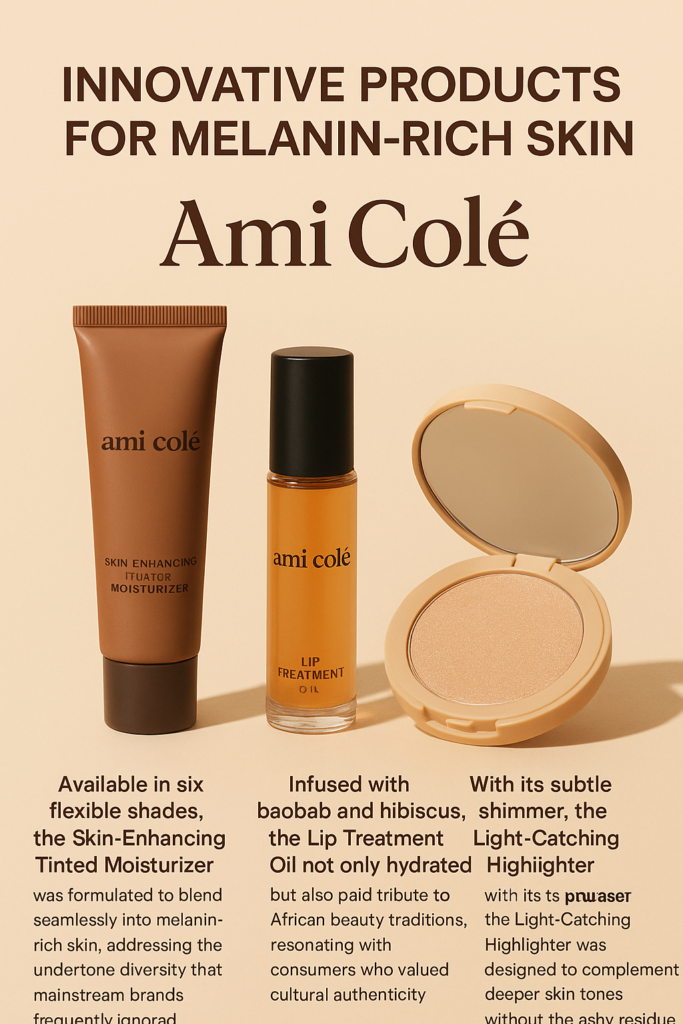
Ami Colé’s product line was a masterclass in intentional design. The brand’s minimalist approach—launching with just three products—reflected a focus on quality over quantity, a rarity in an industry often driven by excess. The Skin-Enhancing Tinted Moisturizer, available in six flexible shades, was formulated to blend seamlessly into melanin-rich skin, addressing the undertone diversity that mainstream brands frequently ignored. Its lightweight, buildable coverage offered a natural glow, aligning with the “no-makeup makeup” trend while prioritizing inclusivity. The Lip Treatment Oil, infused with baobab and hibiscus, not only hydrated but also paid tribute to African beauty traditions, resonating with consumers who valued cultural authenticity. The Light-Catching Highlighter, with its subtle shimmer, was designed to complement deeper skin tones without the ashy residue common in other highlighters.
Ami Colé was crafted for Black and brown women to shine naturally.
Beyond its formulations, Ami Colé’s packaging was sleek and modern, reflecting Harlem’s vibrant aesthetic. The brand’s visual identity—clean lines, warm tones, and imagery featuring Black and brown women—set a new standard for representation in beauty marketing. Ami Colé distinguished itself through its authentic voice and cultural fluency, deeply rooted in its Harlem, New York heritage.. Its products were not just cosmetics but tools for self-expression, empowering consumers to embrace their natural beauty.
Community Impact and Engagement
Ami Colé’s connection to Harlem extended beyond its origin story. The brand actively engaged with its community through pop-up events, social media campaigns, and partnerships with local influencers and beauty creatives. In New York, Ami Colé hosted workshops and beauty panels that celebrated Black and brown voices, fostering dialogue about inclusivity in the industry. These initiatives created a space for consumers to share their experiences, reinforcing the brand’s role as a cultural touchstone. By prioritizing community feedback, Ami Colé ensured its products evolved in response to real needs, such as expanding shade ranges and introducing new textures based on customer input.
The brand also leveraged digital platforms to amplify its message. Ami Colé used Instagram and TikTok to share tutorials and testimonials, emphasizing how its products complement a wide range of skin tones.This approach not only built a loyal following but also inspired other brands to prioritize inclusivity. The brand’s emphasis on clean beauty—free of parabens, sulfates, and synthetic fragrances—appealed to a growing demographic of conscious consumers, further cementing its influence.
Challenges and Closure
Despite its achievements, Ami Colé encountered major challenges that ultimately led to its closure in September 2025. The beauty industry is notoriously competitive, with high costs for production, marketing, and distribution. As a small, Black-owned brand, Ami Colé navigated systemic barriers, including limited access to capital and retail partnerships. While the brand secured investment from firms like Imaginary Ventures and raised over $4 million in funding, scaling operations while maintaining its commitment to clean, high-quality ingredients proved financially taxing. The closure announcement, shared via Instagram, cited “insurmountable challenges” but expressed gratitude to the community that championed the brand.
The closure sparked conversations about the difficulties faced by Black-owned businesses in sustaining growth. Industry observers noted that Ami Colé’s reliance on direct-to-consumer sales, while initially successful, limited its reach compared to brands with major retail distribution. Yet, the brand’s impact was undeniable, as it paved the way for other beauty startups to prioritize inclusivity and cultural authenticity.